Coast FIRE Calculator
There's a point where you can stop saving for retirement entirely and still retire on time. Most people blow right past it without ever knowing it was there.
Your Coast FIRE number is the amount that, invested today, grows to your full FIRE number by retirement age with no further contributions.
Your Results
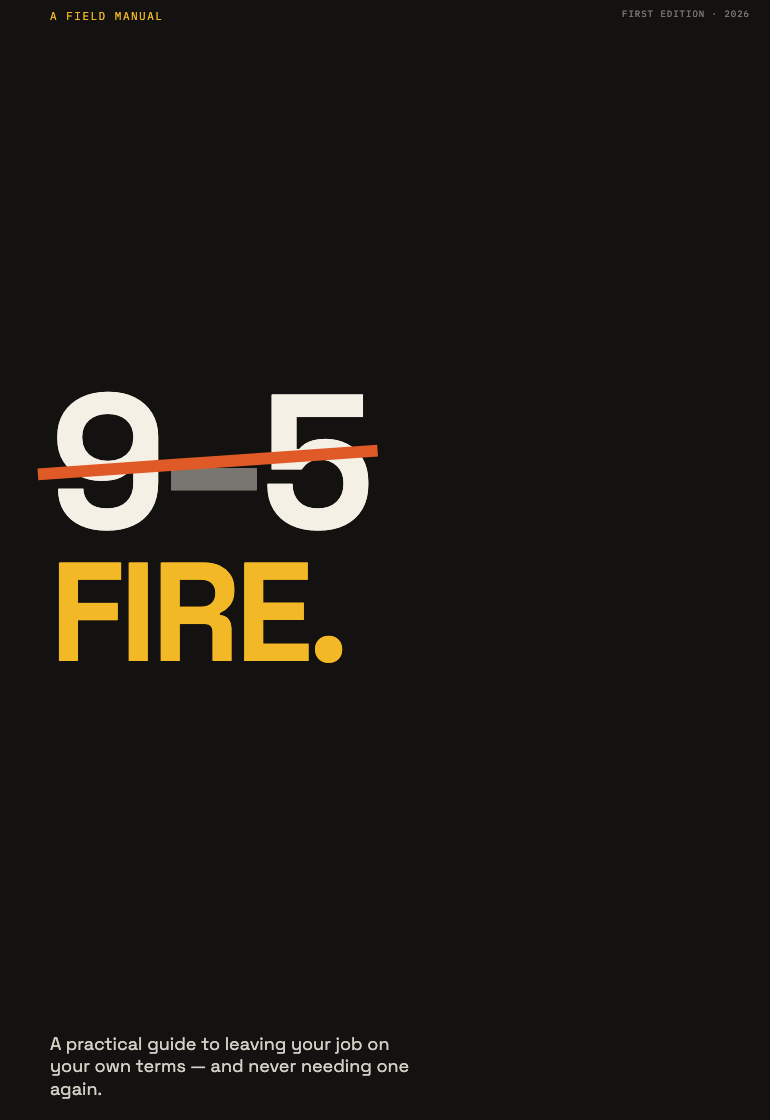
Escape the 9-5 with FIRE
You just ran the numbers. The number is the easy part.
The gap between your coast number and the day you actually retire is measured in decades. A lot can drift in that time. The book covers the moves that keep the plan on track and the traps that reset it, in 36 pages with no fluff.
Instant download, both PDFs. 14-day guarantee. Read the full table of contents →
FIRE Planning Workbook
You found your number. The Workbook shows you how to keep it through the tax maze.
It's the Google Sheet you'd build yourself if you had a CPA and a free month.
Not sure which? Start with the $27 book. The workbook will still be here when you finish it.
Coast FIRE Calculator: stop saving, start coasting
Coast FIRE (also written CoastFIRE) is the point where you stop actively saving for retirement, and let compound growth finish the job. Your portfolio is big enough today that, with zero new contributions, it grows to your full FIRE number by traditional retirement age.
Use this Coast FIRE calculator to find the exact number: how much you need invested right now so you can downshift, take the lower-stress job, or go freelance without wrecking your retirement.
Planning as a pair? The Coast FIRE calculator for couples runs the same math on one joint portfolio and household spending.
Expecting income later in retirement? There are dedicated versions with a pension and with Social Security that split the target around the year the checks start.
How Coast FIRE works: pick your target retirement age, set your annual retirement spending, and the calculator works backwards to find today's coast number. The math: Coast number = (annual spending × 25) ÷ (1 + return)years. Every year you delay Coast FIRE, the number grows, because compounding has less time to work. Hit Coast FIRE 10 years earlier and you roughly halve the required portfolio.
Coast FIRE vs Standard FIRE: Standard FIRE means full early retirement with no job needed. Coast FIRE means optional work decades earlier: you still cover current expenses, but you never have to save another dollar toward retirement. For most people it's the fastest way to make work optional.
How the Coast FIRE calculator works
The starting point is the 4% rule: your full FIRE number is annual spending divided by your withdrawal rate, the framework William Bengen established in 1994 and the Trinity Study later confirmed against a century of US market history.
Coast FIRE runs that math backwards. Instead of asking how much you have to save, the calculator discounts your FIRE number by the expected return for every year between your current age and your retirement age. What remains is the coast number: the amount that, left untouched, compounds to the full target on schedule.
Everything runs in your browser as you type. No account, no server, and your numbers never leave the page.
Coast FIRE numbers by age
The table assumes $50,000 in annual retirement spending, a 4% withdrawal rate, 7% average annual return, and retirement at 65. The younger you are, the smaller the portfolio that can coast to the full $1,250,000 FIRE number. The full age-by-age reference tables cover every age from 20 to 60.
| Current age | Coast FIRE number | Share of full FIRE number |
|---|---|---|
| 25 | $83,475 | 6.7% |
| 30 | $117,079 | 9.4% |
| 35 | $164,209 | 13.1% |
| 40 | $230,311 | 18.4% |
| 45 | $323,024 | 25.8% |
| 50 | $453,058 | 36.2% |
What this calculator assumes (and what it leaves out)
The coast number assumes you add nothing more from today: one sum, left alone, compounding at a single constant return until retirement age. Real markets never deliver a smooth 7% every year, and the further away your retirement age is, the wider the honest range around any single answer. Taxes, investment fees, and Social Security are not modeled.
Sources: William Bengen's 1994 study in the Journal of Financial Planning and the 1998 Trinity Study, both linked above. Last reviewed: July 21, 2026, with defaults and formulas re-checked.
Frequently asked questions
What is Coast FIRE?
Coast FIRE means you have enough invested today that compound growth alone will carry your portfolio to your full FIRE number by traditional retirement age. From that point on you only need to earn enough to cover current expenses. Retirement is already funded.
How do I calculate my Coast FIRE number?
Divide your full FIRE number by (1 + expected return) raised to the number of years until retirement. Example: $50,000 of annual spending at a 4% withdrawal rate means a $1,250,000 target. With 35 years to go and 7% growth, you need about $117,000 invested today. The calculator above runs this math live for any age, spending level, and return.
What return rate should I use for Coast FIRE?
Coast FIRE is more sensitive to this assumption than any other FIRE variant, because growth does all the work. The default is 7%, a conservative before-inflation figure. For a target in today's dollars, use a real return of about 5% instead: the same $1,250,000 target then needs roughly $227,000 today rather than $117,000. Run both and treat the spread as your realistic range.
Coast FIRE vs Barista FIRE: what is the difference?
Coast FIRE means retirement is already funded and you work only to cover today's bills, in any job that pays them. Barista FIRE means you semi-retire on a smaller portfolio and rely on part-time income to cover part of your spending for years. The two answer different questions: Coast tells you when saving becomes optional, while Barista tells you how much part-time income shrinks the portfolio you need. The Barista FIRE calculator runs that version.
Can I keep saving after reaching Coast FIRE?
Yes. The coast number is a floor, and it marks the point where saving becomes optional rather than required. Keep contributing and you retire earlier than your target age, or land above your FIRE number with a bigger cushion. Many people keep saving anyway; the difference is that the pressure is gone.
Does the coast number account for inflation?
Only if you feed it a real return. With a nominal figure like the 7% default, your target is in today's dollars while the growth isn't, which flatters the result over long horizons. Enter roughly 5% (the historical inflation-adjusted return) and both sides of the math read in today's dollars. Over 35 years the gap between the two is close to a factor of two, so it's worth a second run.
Who runs this site?
Just me, Jonas. No team and no sponsor. I made these because I wanted to pressure-test my own numbers without handing an email address to every site that has a calculator. Everything runs in your browser and nothing you type is sent anywhere. A $27 ebook and a $67 planning workbook cover the costs. I'm not a financial advisor; the about page has the longer story.
Test your withdrawal rate
See how often a 4% (or any) withdrawal rate has historically survived your retirement length.
Open the SWR Calculator →