Lean FIRE Calculator
Most FIRE calculators anchor you to a million dollars or more. If you live lean, that number is far higher than you actually need.
Your Lean FIRE number is the portfolio a deliberately low-spending life needs to retire early: annual spending divided by your withdrawal rate, kept small by keeping expenses small.
Your Results
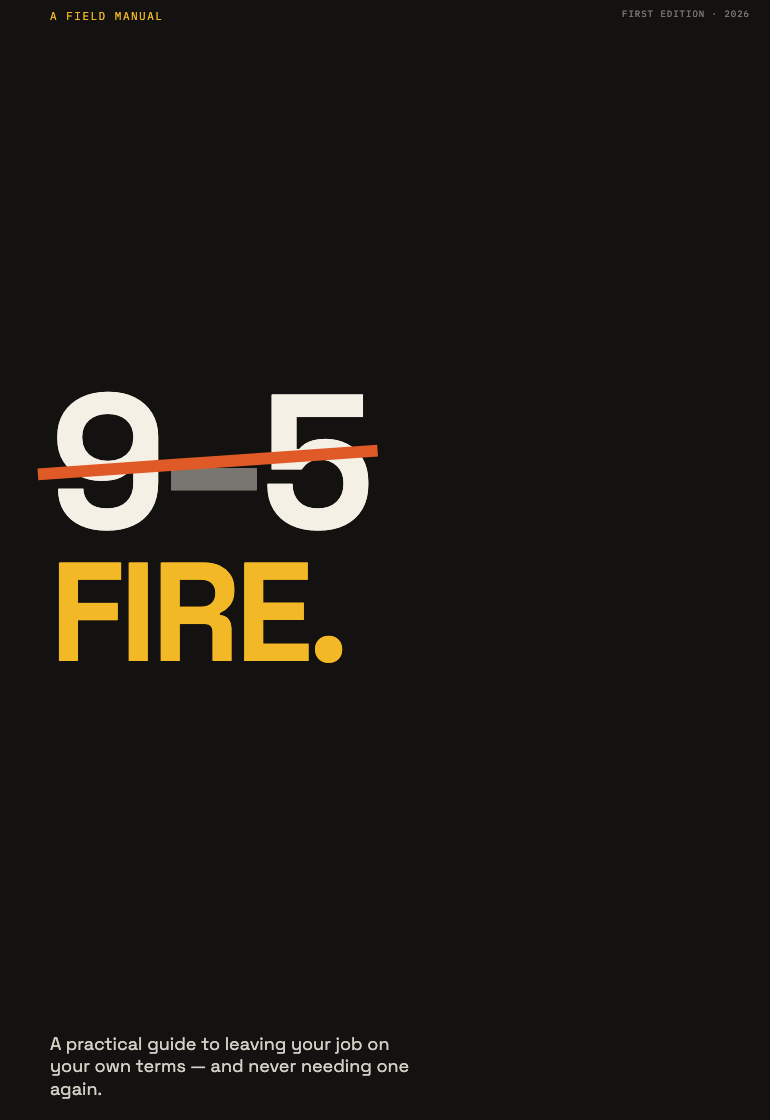
Escape the 9-5 with FIRE
A lean number gets you out fast. The book keeps you out.
A small portfolio leaves little margin for error, so the moves matter more, not less. This book covers the parts a calculator can't: which accounts to draw from first, how to hold healthcare costs down, and how to keep a lean plan from breaking when one year goes wrong. 36 pages, no fluff.
Instant download, both PDFs. 14-day guarantee. Read the full table of contents →
FIRE Planning Workbook
On a lean budget, every dollar of tax matters more. This is where lean retirees win or lose.
It's the Google Sheet you'd build yourself if you had a CPA and a free month.
Not sure which? Start with the $27 book. The workbook will still be here when you finish it.
Lean FIRE Calculator: retire early on a smaller number
Lean FIRE is early retirement built on a deliberately low-spending life. The math is the same as any FIRE plan: your number is your annual spending divided by your safe withdrawal rate. The difference is the input. When you spend less, the number you need to hit collapses with it.
At a 4% withdrawal rate, your FIRE number is your spending times 25. Live on $50,000 a year and you need $1,250,000. Live on $28,000 and you need $700,000. That gap of half a million dollars is the entire reason Lean FIRE exists, and it can pull your retirement date forward by a decade or more. The 4% rule behind that math comes from William Bengen's 1994 study and the Trinity Study.
Spending is the lever that moves the number fastest. Every $1,000 you trim from annual expenses lowers your target portfolio by $25,000. A household that gets comfortable at $30,000 a year is chasing $750,000. One that lives on $24,000 is chasing $600,000. The frugal habits that lower the number also raise your savings rate today, so they speed you up from both ends.
Use this Lean FIRE calculator to see your exact figure: enter your spending, your income, and what you already have invested. It returns your Lean FI number, your savings rate, and how many years until your portfolio can carry you.
How lean is Lean FIRE?
There is no official line. As a rough guide, people use Lean FIRE to describe a household spending under about $40,000 a year, or a single person under roughly $25,000. Below that you're firmly lean. What matters is less the exact threshold than the fact that you've built a life costing much less than the average, and your FIRE number reflects it.
What makes a lean budget work is usually built into your fixed costs more than it depends on willpower. A paid-off or cheap home removes the biggest line item for most people. Low or no car costs, cooking instead of eating out, and skipping lifestyle inflation as your income rises all compound. Geographic arbitrage (living somewhere with a low cost of living, sometimes abroad) is one of the most powerful levers, because it cuts housing, healthcare, and daily spending at once.
None of this means living miserably. Plenty of lean retirees describe their spending as intentional rather than restricted. They just refuse to pay for things they don't value, which is exactly what makes a $28,000 life feel rich instead of tight.
The risk of cutting it too lean
A smaller number is a smaller cushion. That's the honest trade. A $700,000 portfolio leaves far less room for a major medical bill, a market crash in your first few years, or a long stretch of inflation than a $1.5M one does. When you're already lean, you have fewer expenses left to cut if something goes wrong.
The biggest threat is sequence of returns risk: a bad market early in retirement, while you're withdrawing, can do permanent damage even if average returns over the next 30 years look fine. Lean portfolios feel this harder because the withdrawals are a larger share of a smaller pile. Use the SWR calculator to stress-test your rate against history before you commit.
Most lean retirees manage the risk rather than avoid it: a cash buffer of one to two years, flexibility to cut spending in down years, a real plan for healthcare, and often a small income stream as a backstop. If a part-time paycheck appeals more than pure frugality, look at Barista FIRE, which covers part of your spending with ongoing work and rebuilds the margin a lean plan gives up.
Lean FIRE vs regular FIRE vs Fat FIRE
Lean FIRE is the smallest target: a low-spending life funded by a smaller portfolio, often under $1M. It's the fastest road, with the least margin.
Regular FIRE sits in the middle, with roughly average spending, a portfolio in the $1M to $2M range, enough to live comfortably without extreme frugality.
Fat FIRE is the largest: a high-spending lifestyle of $100,000 a year or more, which means a portfolio of $2.5M and up. It takes the longest to build but keeps the lifestyle and the safety margin intact.
These aren't fixed identities. A common path is to reach Lean FIRE first to buy freedom early, then let the portfolio keep growing toward regular or fat over time. If you'd rather stop adding new money now and let compounding finish the job, that's Coast FIRE. Run your own numbers in the calculator above, then compare against the other modes to see which exit is actually closest.
Lean FIRE numbers by spending level
Lean FIRE lives and dies on the spending figure, so the table starts there. The 3.5% column is the more conservative target many lean planners prefer, since a lean budget has less slack in bad market years.
| Annual spending | Per month | At 4% | At 3.5% |
|---|---|---|---|
| $20,000 | $1,667 | $500,000 | $571,429 |
| $25,000 | $2,083 | $625,000 | $714,286 |
| $30,000 | $2,500 | $750,000 | $857,143 |
| $35,000 | $2,917 | $875,000 | $1,000,000 |
| $40,000 | $3,333 | $1,000,000 | $1,142,857 |
What this calculator assumes (and what it leaves out)
The lean number assumes your low spending level holds for decades, through medical bills and high-inflation years alike. A small portfolio has less slack when reality drifts from the plan, which is why sequence risk (covered above) weighs heavier here than in most FIRE variants. Taxes, investment fees, and Social Security are not modeled.
Sources: William Bengen's 1994 study in the Journal of Financial Planning and the 1998 Trinity Study, both linked above. Last reviewed: July 21, 2026, with defaults and formulas re-checked.
Frequently asked questions
What is Lean FIRE?
Lean FIRE is early retirement built on a deliberately low-spending lifestyle. Because your FIRE number is your annual spending times 25 at a 4% withdrawal rate, keeping expenses low means you need a much smaller portfolio. There's no official cutoff, but most people use the term for a household spending under roughly $40,000 a year, or a single person under about $25,000.
What is the Lean FIRE number?
Your Lean FIRE number is your annual spending divided by your safe withdrawal rate. At 4%, that's spending times 25. Live on $28,000 a year and your number is $700,000. For a longer retirement you might use 3.5%, which raises it to about $800,000. The calculator above works out your exact figure and how soon you reach it.
How much do I need for Lean FIRE?
It depends entirely on how little you spend. Every $1,000 you cut from annual spending lowers your required portfolio by $25,000 at a 4% withdrawal rate. A household at $30,000 a year needs $750,000; at $24,000 a year, $600,000. Many Lean FIRE retirees aim for somewhere between $500,000 and $1,000,000.
Lean FIRE vs Barista FIRE — what's the difference?
Lean FIRE means living on a small portfolio with no required work, funded entirely by a low-spending lifestyle. Barista FIRE means semi-retiring on a smaller portfolio plus ongoing part-time income that covers part of your spending. Lean leans on frugality; Barista leans on a part-time paycheck. Plenty of people blend the two.
Is Lean FIRE risky?
Lean FIRE leaves less margin. A small portfolio has little room for a medical bill, a market crash early in retirement, or years of higher-than-expected inflation. People manage this with a cash buffer, flexible spending, a healthcare plan, or a small income stream as a backstop. The lower your number, the more your plan depends on staying lean for decades.
What return rate should I use?
Long-run US returns have averaged around 10% before inflation and about 7% after, which is why 7% is the default. With a lean budget there is little margin if the assumption turns out optimistic, so it is worth running the numbers at a real return of 5% too: then the whole plan reads in today's dollars.
Who runs this site?
Me, Jonas. One person, no staff. The site exists because most FIRE calculators are either buried in ads or locked behind an account. These are free, need no login, and do all the math in your browser. A $27 ebook and a $67 planning workbook fund the site. I'm not a financial advisor; there's more on the about page.
Want the full FIRE picture?
Compare a leaner or fatter lifestyle, or stress-test your withdrawal rate against history.