FIRE Calculator
Most people will work until they're 65. Not because the work demands it, but because nobody ever showed them the math.
A FIRE calculator works out the portfolio you need before work becomes optional: annual spending divided by your withdrawal rate. Enter six numbers and it projects the year you get there.
Your Results
All calculators on this site
All the calculators: Coast FIRE · Coast FIRE for couples · Barista · Lean · Fat · Safe withdrawal rate · Coast with pension · Coast with Social Security · Coast FIRE numbers by age
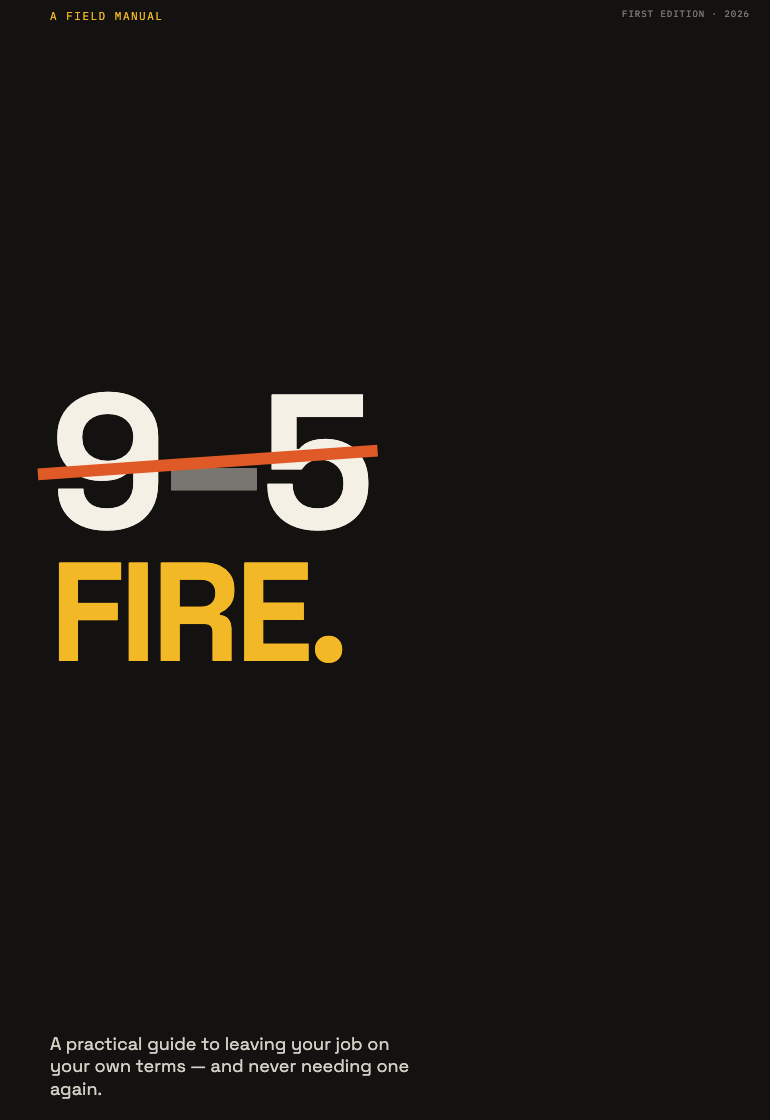
Escape the 9-5 with FIRE
You just ran the numbers. The number is the easy part.
Most FIRE plans fail in the gap between the number and the exit: tax moves done in the wrong order, lifestyle creep that pushes the target further out, and One More Year Syndrome dragging the timeline years past the day someone could have walked away. This book covers that gap, in 36 pages with no fluff.
Instant download, both PDFs. 14-day guarantee. Read the full table of contents →
FIRE Planning Workbook
You found your number. The Workbook shows you how to keep it through the tax maze.
It's the Google Sheet you'd build yourself if you had a CPA and a free month.
Not sure which? Start with the $27 book. The workbook will still be here when you finish it.
FIRE Calculator: find your number, then pick your path
Your FIRE number is the same no matter how you get there: annual spending divided by your withdrawal rate, or roughly 25× your yearly expenses at 4%. What changes is the route. This calculator runs the three most common ones so you can see which exit is closest.
Standard FIRE is full independence: a portfolio big enough that work is entirely optional. It's the biggest number and usually the longest road, and it's what this page opens on.
Coast FIRE is the point where you can stop saving entirely and let compounding finish the job by retirement age. It usually arrives years before full FIRE. Run it on the dedicated Coast FIRE calculator to see how much you need invested today to stop contributing. Couples can run the household version instead.
Barista FIRE means semi-retiring now on a smaller portfolio, with part-time income covering part of your spending. The Barista FIRE calculator handles the part-time income math. Want to retire on the leanest possible number, or the fattest? There's a Lean FIRE and Fat FIRE calculator too.
How the FIRE calculator works
This calculator uses the 4% safe withdrawal rule, the cornerstone of the FIRE movement. It was established by William Bengen in 1994 and confirmed by the Trinity Study: if you withdraw 4% of your portfolio in year one of retirement and adjust for inflation annually, your portfolio has historically survived 30+ years in 96% of scenarios.
Your FIRE number is your annual retirement spending divided by your withdrawal rate. At 4%, that's your annual expenses multiplied by 25. Once your invested portfolio reaches this number, you're financially independent and work becomes optional.
The calculator iterates year by year, growing your portfolio at the expected return and adding your annual savings, until it crosses your FIRE number. It runs in your browser as you type, and your numbers never leave the page.
FIRE numbers at a glance
Every cell below is annual spending divided by a withdrawal rate. The 4% column matches the calculator's default; the lower rates show what extra cushion costs.
| Annual spending | At 4% (25×) | At 3.5% (≈28.6×) | At 3% (≈33.3×) |
|---|---|---|---|
| $30,000 | $750,000 | $857,143 | $1,000,000 |
| $40,000 | $1,000,000 | $1,142,857 | $1,333,333 |
| $50,000 | $1,250,000 | $1,428,571 | $1,666,667 |
| $60,000 | $1,500,000 | $1,714,286 | $2,000,000 |
| $80,000 | $2,000,000 | $2,285,714 | $2,666,667 |
| $100,000 | $2,500,000 | $2,857,143 | $3,333,333 |
What this calculator assumes (and what it leaves out)
The projection compounds once a year: savings (income minus spending) go in, the balance grows at your expected return, and the run stops when it crosses your FIRE number. It does not model taxes, investment fees, Social Security, or pensions. If those matter for your plan, fold them into your spending figure and treat the result as a planning estimate.
Sources: William Bengen's 1994 study in the Journal of Financial Planning and the 1998 Trinity Study, both linked above. Last reviewed: July 21, 2026, with defaults and formulas re-checked.
Frequently asked questions
How does a FIRE calculator work?
A FIRE calculator takes your age, income, spending, and current investments, then projects your portfolio one year at a time: each year the balance grows at your expected return and your annual savings are added on top. The year the projection crosses your FIRE number is the year work becomes optional.
What is the FIRE number?
Your FIRE number is the total investment portfolio you need to retire early. It's your annual retirement expenses divided by your safe withdrawal rate. At 4%, your FIRE number is annual expenses × 25. If you spend $50,000/year, your FIRE number is $1,250,000.
What is the 4% rule?
The 4% rule states that you can safely withdraw 4% of your portfolio in year one of retirement, then adjust for inflation each year, with a high probability (around 96%) that your portfolio will last 30+ years. It was established by William Bengen's 1994 study and confirmed by the 1998 Trinity Study. Some financial planners suggest 3.5% for early retirees planning for 40–50 year retirements.
What inputs do I need?
Six numbers: current age, annual income, annual spending, current invested savings, expected return, and a withdrawal rate. Spending is the one to get right, because it counts twice: it sets your annual savings (income minus spending) and it sets the target itself. Cutting $1,000 from annual spending shrinks your FIRE number by $25,000 at a 4% withdrawal rate.
What return rate should I use?
The US stock market has returned approximately 10% annually before inflation (7% after inflation) over long historical periods. This calculator defaults to 7%, a conservative before-inflation figure. Because your FI number is based on today's spending, the cleanest setup is a real return: enter 5% and the whole timeline reads in today's dollars.
How much do I need to retire at 40?
To retire at 40, you need 25× your annual expenses (at 4% SWR). If you spend $50,000/year, you need $1,250,000. For a 50-year retirement, consider using 3.5% SWR instead, which works out to about 28.6× your expenses, or roughly $1,430,000 for $50K annual spending. The earlier you retire, the more conservative your withdrawal rate should be. The guide to retiring at 40 works through the numbers.
Who runs this site?
One person: me, Jonas. I built these calculators because the alternatives were either ad-farms wrapped around a widget or full planning suites that want an account before they show you a number. The calculators are free, there is no login, and your numbers never leave your browser. A $27 ebook and a $67 planning workbook pay for the site. I'm not a financial advisor, and nothing here is financial advice. More on the about page.
Test your withdrawal rate
See how often a 4% (or any) withdrawal rate has historically survived your retirement length.
Open the SWR Calculator →